


How Companies Are Recognizing Employee Service Milestones in 2026
Recognition in the workplace goes far beyond a quick "Good job!" or a "Great effort on this one! Here's a voucher." Employees may appreciate small gestures, but loyalty and productivity aren't built on sweet words and Friday pizza.
It takes a solid, intentional strategy rooted in meaningful appreciation to keep people (especially the good ones) happy.
Perhaps surprisingly in our chronically digital age, tangible recognition (awards, trophies, plaques, etc.) continues to play a big role in building lasting employee engagement. Service awards are a good example, so let's look at the psychology behind them and what the IRS allows.
Tangible Recognition and Its Emotional Value
Modern workplace culture is a hybrid between physical and digital.
Even in companies where remote work is not possible or accepted, communication happens online: emails, Slack messages, and shared documents are all digital. And so is recognition. Newsletter shout-outs, virtual badges, and email blasts (aka informal recognition) tend to be used for quick, day-to-day validation.
Yet, these tools can only do so much.
A digital shout-out cannot hold the weight of major career milestones like a 5-, 10-, or 20-year service anniversary. Which employee would be happy with a rapidly disappearing "Thank you!" on Slack after they've just helped the company close a multi-million-dollar deal?
That's why a solid recognition strategy needs four legs to stand on:
- Day-to-day appreciation (which is usually digital or verbal)
- Dedicated programs (clearly defined with steps and milestones)
- Performance bonuses
- Physical tokens of employee appreciation
While all the steps matter, the only ones that translate well into the real world are the physical tokens. They are the tangible items that employees can proudly display on desks, walls, and shelves. Due to the symbolism they hold, anyone seeing these tokens of appreciation immediately understands their importance.
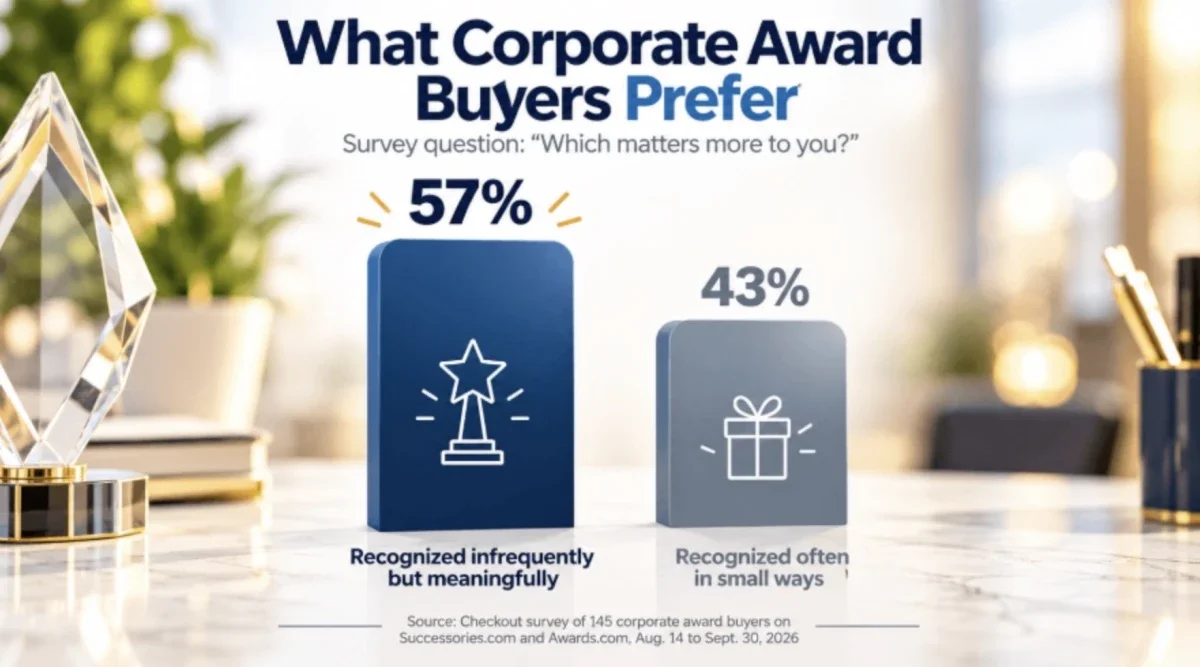
That matches what buyers report. In a checkout survey of 145 corporate award buyers on Successories.com and Awards.com (Aug. 14 to Sept. 30, 2026), 57% said infrequent but meaningful recognition matters more to them than frequent recognition in small ways.
Symbolism and Staff Engagement
Without meaning attached to it, a crystal award or a trophy is nothing more than a glorified paperweight. But add a personalized engraving and reserve it for major career milestones, and it transforms into a visible symbol of status and hard-earned pride.
Besides the symbol attributed by the company, the shape, size, and material of a physical token of appreciation also matter. Here's a quick breakdown of how some of these items are seen in the professional world:
- Engraved awards: Celebrate major employee milestones like Employee of the Year or leadership excellence
- Wooden/Metallic plaques: Awarded for long tenure, service anniversaries, or retiring leaders
- Lapel pins: Badges for continuous loyalty and explicit rank within the organization
- Custom challenge coins: Symbolize shared sacrifice, elite group membership, and deep camaraderie
- Certificates of achievement: Highlight formal credentialing and official institutional validation
What's in It for the Business?
There's a clear benefit for the companies that include tangible recognition in their strategies: an increase in employee engagement and loyalty. Yes, people like to feel seen and valued, but there's more to this.
Awards and trophies act as a benchmark for an employee's past achievements. They speak of a certain reputation. They increase peers' expectations and motivate the awardee to uphold said reputation in future projects.
As an added bonus, service awards can be tax-free for employees, within limits.
Under Section 274(j) of the Internal Revenue Code, employee achievement awards, including service awards, can be tax-free when they are tangible personal property such as plaques, trophies or engraved gifts. Cash, gift cards, cash-equivalent points, vacations, meals, lodging, event tickets and securities don't qualify.
To keep awards tax-free for employees and fully deductible for your business, the IRS set several parameters:
- The amount: Businesses can deduct up to $400/employee per year
- Length of service: a service award isn't tax-free if it's given in the employee's first 5 years, or if the employee received another service award that year or in the prior 4 years
- Meaningful presentation: The award must be presented as part of a distinct, formal moment that highlights the employee's specific contribution
- No disguised pay: the award can't be given under conditions that make it look like compensation
Pro tip: If given under a formal, written award plan that does not favor highly compensated employees, that limit jumps to $1,600 per employee (provided the average cost of all awards under the plan remains at $400 or less).
Source: IRS Publication 15-B (2026) and 26 U.S.C. 274(j). The rules depend on how your award plan is set up, so check with your tax advisor before setting award values.
Recognition in Modern Employee Engagement Strategies
Managers don't have to choose between digital perks and physical awards. It can (and should) be both. Digital shout-outs sustain daily momentum, while formal recognition marks major employee milestones.
The goal is to build a hybrid recognition ecosystem where everyone feels free to offer congratulations and words of encouragement when and where relevant.
Here are a few tips that help build such an ecosystem:
Friction-Free Peer Recognition
Let peer-to-peer recognition (shout-outs or points in a recognition platform) flow freely and naturally. There's no need for heavy approval layers from management for a digital pat on the back.
A positive workplace culture makes it easy to show appreciation toward a colleague's efforts.
Don't Skip the Story (Public Attribution)
When presenting a physical award, always frame it with a specific story explaining why the employee earned it. It's a matter of pride for the person receiving the award, but also a way to show other employees how they can become recipients in the future. Plus, there's a tax benefit you don't want to miss.
Match the Medium to the Magnitude
Professional recognition is a fine art. It requires matching the scale of the reward to the size of the milestone.
To hit just the right spot, reserve physical awards for high-stakes milestones. A 10-year anniversary or the successful completion of a major, year-long project warrants a plaque or a team trophy.
If you hand out plaques and awards for every routine task, you dilute their meaning. On the other hand, marking a decade of loyalty with a Slack message feels dismissive and, quite frankly, rude.
Building a Recognition Strategy That Maintains Engagement
Employee engagement and loyalty go hand-in-hand with recognition. After all, when management doesn't appreciate the staff's hard work, why would anyone bother?
It doesn't take a mastermind to design a recognition strategy for engagement. It's a combination of quick shout-outs that keep momentum alive during the week and knowing how to celebrate major milestones that have real weight behind them.
So, don't let your biggest company achievements fade into an unread email thread. Combine structured programs, cash incentives, and physical mementos to build a recognition culture that employees can actually see, hold, and take pride in for years to come.